Do you live in the problem or the solution?

Hey Gardeners! I hope everyone had a wonderful holiday season. Since the last post, I have transitioned to a new job, and I am loving it. I will always have an educator’s heart; however, a new adventure is always good for the soul. Which leads me to our next topic—Where do you live? By this, I mean, when problems arise, where do you go? As always, let’s dive in.
💕🌻💕🌻💕🌻
What is a “problem?”
I know, “Tori, we know what a problem is. We face problems every day in a ton of ways.” True—but how long do you stay in the problem? How long do you wait or focus on the situation? From personal experience, I will say that I spent much time in the problem when I was younger. I had to call various people, get their opinions, call my parents, and make a snap story. I had to do everything except stop, pray, and listen. If this sounds like a previous life experience for you, please join me in telling the Lord, “Thank You.”
So now, my next question is, “What does it cost to live in the problem, and what do we hide there? I will tell you how much it costs—everything. All the things that we work for when we decide to heal. Another question I have is this—“What’s harder—lying in defeat or fighting for your peace of mind?”
Where do we go when we live in the problem?
Anger
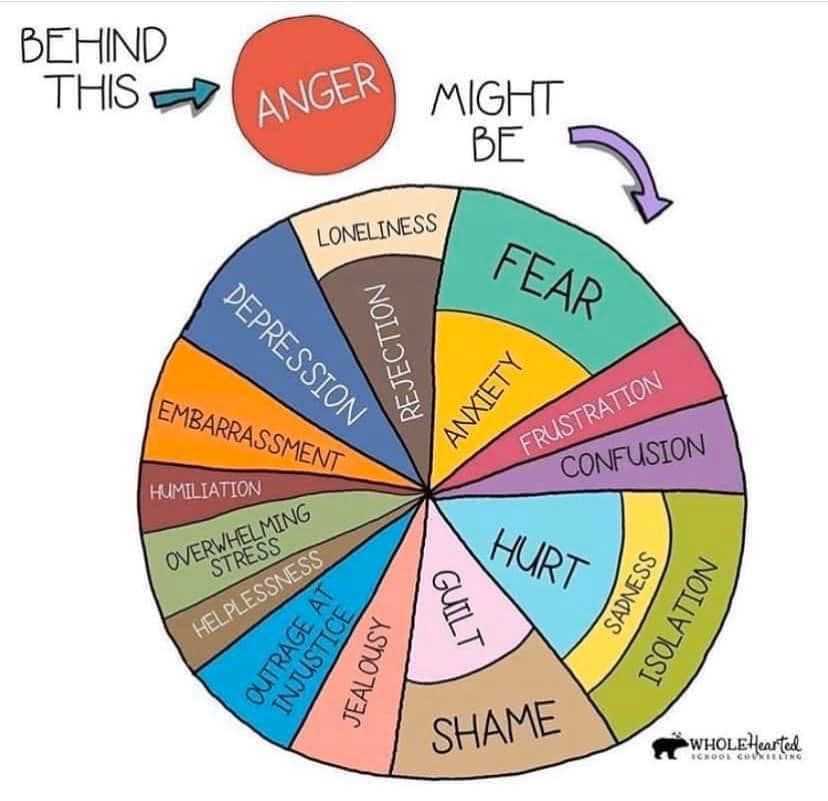
Dr. Brené Brown defines anger as “…an emotion that we feel when something gets in the way of a desired outcome or when we believe there’s a violation of the way things should be.” Atlas of the Heart, p. 220. Language has become one of my favorite things, and I work hard nowadays to define emotions in a way that I understand, and Dr. Brown helps me with a lot of that. Anger is such an ever-present thing. It is such a vehicle, and if it’s not controlled, it grows into a semi-truck with balding tires and no brakes. Something that has helped me is getting to the root of my anger. I have mentioned this quote before, but I will repeat it, “Anger is sadness’s bodyguard.” When dealing with problems, the visible emotion is typically the one we roll with. “I am mad—I am angry.” But what if it was more profound than that? What if anger was masking something else? Like fear or depression? When living in the problem, it’s easy to stay angry—but what happens when you come out? When you dig deep and get to the root?
“Anger is a catalyst. Holding on to it will make us exhausted and sick. Internalizing anger will take away our joy and spirit; externalizing anger will make us less effective I our attempts to create change and forge connection. It’s an emotion that we need to transform into something life-giving: courage, love, change, compassion, justice.” Atlas of the Heart, p. 225.
Betrayal
Nothing hurts more than the feeling of betrayal. Right? When you trust someone, and they let you down, or when you put all your faith in it not raining on your hair day, and it does it anyway? That last one happens to me often, and I am ALWAYS in shock. On a serious note, it hurts when your expectations aren’t met, or your trust has been broken. It can lead to some dark thoughts of not being worthy, it can bring on anxiety, and it can also mess with your ability to trust yourself. When problems grow, they can act as a cancer, seeping into your heart, mind, and even your soul and rerouting you as a person. Betrayal from outside sources hurts, but when you feel like you betrayed yourself—that’s when the terrible sets in.
💕🌻💕🌻💕🌻
Defensiveness
“At its core, defensiveness is a way to protect our ego and a fragile self-esteem.” Atlas of the Heart, p. 196. Going on the defense! Typically, a statement I would equate to sports, but when you’re in the thick of it, and it feels like the ship is going down, I cannot speak for you, but I know for me—I will not be made a fool. I will do what it takes to protect myself and what I love. As much as that seems like an honorable trait, it can become a problem. Living in a constant state of defense is like living with a high-voltage light on at all times. How can you sleep? When do you rest? Are you just waiting for the next person or thing to try you? Defense can win games, but it can also destroy peace, so it might not be the best stop on our tour to self-love.
Hurt
I saved hurt for last on my list of problem residences. I wanted to make sure that I gave hurt its due. I spent a great deal of time at this stop. It kept me from growing at the rate in which I should have. The hardest thing to say as an adult is, “That hurt my feelings.” Whether it was words, an event, or a memory that came back to visit, it take a great deal of courage and strength to acknowledge hurt. Once you recognize the hurt, then you have to process it. Processes take a lot of work, time, and effort. The work that goes into hiding our hurt is exhausting, and honestly, it consumes too much energy. But here’s the thing about hurt: you cannot put it down. As much as we’d like to stop hurting, we cannot. You cannot go through life trying to avoid hurt—then you’re not taking risks. You’re not loving wholeheartedly or living authentically. To hurt is to be alive, and we want to be alive. We want to live and create a life we can be proud of.

So what about being solution-oriented?
Well! I found three things that I think we can work with. I am pretty sure this list could be longer, but for the sake of time—let’s start with three.
1. Facing the fear of traveling a path alone.
Sometimes, we make decisions to better ourselves that cause us to leave some things or people behind. That can be scary. But what if I told you that humans naturally pull towards being the best we can be? God made us that way. He calls for us to come home to him, and we know those paths are often ones we must travel alone.
2. Admitting the role I played in my own suffering.
This is hard. What if I cannot get over the lengths I went to be accepted? What if I have hurt myself too much and I cannot see the solution? Guys, we are resilient people. Seriously, look at how long humans have survived. I am 100% positive that even though you have played a role in this—you can get through it. I did. I got through, and I am still getting through, and the transparency that I give myself—the grace that I extend myself—makes me a better person. So yes, I am guilty of taking too much, taking too little, saying too much, and saying too little, and that is okay.
3. Accepting that things are happening for you and not to you.
Dottie Peoples is one of my favorite Gospel artists. And she has this song, “For My Good,” and in this song, she says, “God meant it for my good.” When I was younger and going through things, I would think, “Now I just know God wouldn’t do me like this.” 😂 I can laugh at it now because he wasn’t doing anything TO me; he was trying to show me how these unfortunate events are here to make me a better woman—a woman after his own heart.
💕🌻💕🌻💕🌻
So, as much as I wish we lived in a world full of good, growth, and more people coming home to God, I realize that we do not. It does not happen that way. I can choose to live in the sadness of that, or I can live with a solution in mind. I think I’ll choose the solution—it’s been lovely here.

Take care,
ToriB💕🌻

 Garden of Growth 💕🌻
This was thoroughly a very detailed discussion of how we can grow when we accept or recognize that we can be in the problem or the solution. Walking with God will help us walk through this garden of life. ❤️❤️🙏🏾
LikeLiked by 1 person